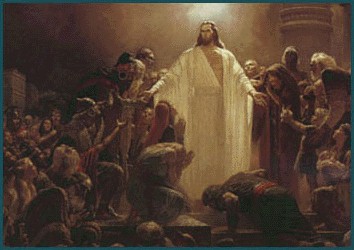
Keep your eyes
open!...
Tribulation Times
Subscribe
Unsubscribe
View Archives
READ
THE BIBLE IN ONE YEAR: https://bibleinayearonline.com/april-oyb/?version=63&startmmdd=0101
April 23, 2026
(1Pe 5:8-11) Be
sober and watch: because your adversary the devil, as a roaring lion,
goeth about seeking whom he may devour. Whom resist ye, strong in
faith: knowing that the same affliction befalls, your brethren who are
in the world. But the God of all grace, who hath called us unto his
eternal glory in Christ Jesus, after you have suffered a little, will
himself perfect you and confirm you and establish you. To him be glory
and empire, for ever and ever. Amen.
ZENIT.ORG: Mexican bishops warn of a nation at risk: violence, the Cristero War, and the World Cup
CHURCHPOP: Christ Is Risen—So Why Do We Still Suffer? The Easter Answer Catholics Need
GOOD CATHOLIC: What St. John Vianney Taught About the Value of Suffering
EXCERPT CARMELITE QUOTES: The Cross: The Fullness of God — Silvio José Báez, ocd
On this Third Sunday of Easter, we
hear the beautiful story of the disciples on the road to Emmaus.
Two of Jesus’ disciples—witnesses of his crucifixion—sad and
disillusioned, are on their way back to Emmaus.
As they walk, they talk about
everything that happened in those days in Jerusalem (Lk 24:14).
The death of Jesus—he in whom they had trusted, the one they had
followed—left them deeply disappointed. They need to talk about
it. They need to remember. They need to share what they’ve
lived through. And yet, even as they talk, they are still trapped
in the painful past. They can’t yet see any reason to hope.
Their experience brings to mind,
almost spontaneously, the recent history of the people of
Nicaragua. Eight years ago, the people rose up peacefully against
a criminal dictatorship that reacted with violence—repressing and
killing hundreds of Nicaraguans. The regime has imposed a
repressive police state that has stripped away all freedoms and left a
painful legacy of imprisonment, exile, and death. Like those two
disciples on the road to Emmaus, Nicaragua is the walking wounded—often
filled with uncertainty, but always longing for freedom, peace, and
justice.
When we carry such a painful
history on our shoulders, we run the risk of becoming discouraged,
losing hope, like the disciples of Emmaus. They were walking, but
they were still trapped in the painful events that had occurred just a
few days earlier, when they saw Jesus die, without finding a reason to
keep going.
The Risen Jesus offers reasons to
hope and new strength to keep building a better future for the people
of Nicaragua. With Jesus at our side, walking with us, the
suffering we’ve endured can become a new impetus to keep going; in our
powerlessness, we can discover the strength of God that propels us
forward; our mistakes can become a lesson that sets us back on the
right path; and our sadness and discouragement can become strength to
change history.
We mustn’t fall into the illusion
that the true victors are those who impose themselves with
weapons. Nor should we let ourselves be deceived by the distorted
reading of history put forward by those in power, who present
themselves as victims and accuse the real victims. The
Resurrection of Jesus assures us that, just as his crucifixion once
seemed like a defeat, what happened eight years ago has in fact been
the great victory of a people who are already rising again, because
they refuse to submit to unjust oppression and to the theft of their
own history.
The disciples invite Jesus to stay
with them. As they sit at table, Jesus takes the bread, blesses
it, breaks it, and gives it to them (Lk 24:30). Then the eyes of
the two disciples are opened, and they recognize him (Lk 24:31).
In that broken bread, Jesus is present—he feeds us with the strength of
his love in every Eucharist. In the Eucharistic bread, we find
the strength that sustains us and the love that guides us. The
people of Nicaragua are not only courageous, but also a people who
believe. May Jesus, the Bread of Life, always sustain our journey
and be our nourishment in moments of doubt and weariness.
Before that broken bread, the
disciples finally came to understand the meaning of history. The
Eucharist teaches us how the future is built: by becoming bread broken
for the life of the world. The people of Nicaragua must not
forget this. It’s not about seeking more victories, but about
daring to lose out of love—giving ourselves generously so that others
may live, and continuing to struggle so that a society marked by
freedom, justice, and peace may take shape, without victors or
vanquished.
RELATED NEWS
Ladder
of Divine Ascent excerpt: Step 7- "On Joy-Making Mourning"
5.
If you possess the gift of mourning, hold on
to it with all your might. For it is easily lost when it is not firmly
established. And just as wax melts in the presence of fire, so it is
easily
dissolved by noise and bodily cares, and by luxury, and especially by
talkativeness
and levity.
Prayer
request? Send an email to: [email protected]
"Have ANY
Catholic Question? Just ask Ron Smith at: [email protected]
This month's archive can be found at: http://www.catholicprophecy.info/news2.html.